Appetite, in company
Dinner, according to GLP1 Me
The name ends with me. I want room at the table for hunger, fullness and the business of eating, alongside the weight curves.

Eating in the exit interviews
I pulled up a chair for the retatrutide paper that involves a conversation. In exit interviews with 40 phase 2 trial participants, 31 of the 36 people who received retatrutide reported changes in eating behaviour within the first 8 weeks. Their accounts included less frequent hunger, greater satiety, smaller portions, changed food preferences and a stronger sense of control over eating.
Control deserves the closest attention here, I think. A portion has a size; the experience of deciding when to stop eating has a texture that a weight curve cannot supply. These interviews make that experience available for discussion. They also concern a particular group of trial participants, speaking about perceived benefits.
The breadth of these accounts impresses me. A single, ideal appetite sounds much less appealing. Hunger, fullness and control deserve separate seats at this table.
Weight change in the phase 2 trial
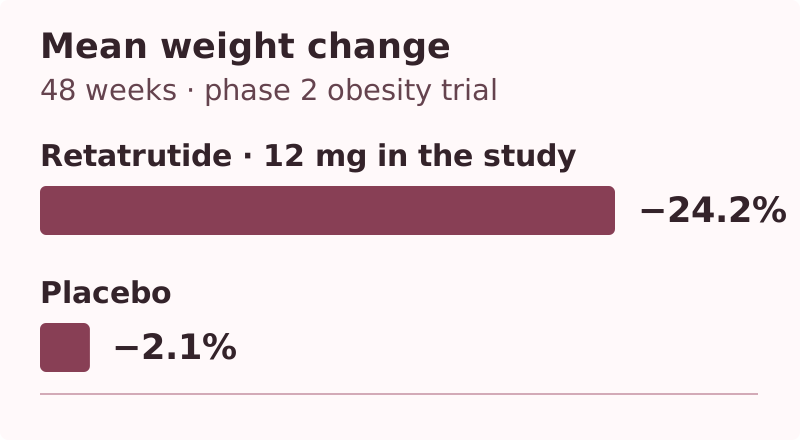
The 48-week obesity trial enrolled 338 adults. At the study’s 12 mg dose, mean body-weight change was −24.2%, compared with −2.1% for placebo. That is a substantial result.
That percentage makes a tempting opening. Still, the interview accounts give the weight result an everyday setting: portions, preferences and the feeling of being able to stop. The measurements and the accounts answer different questions. The accounts bring daily life into the argument; the group result still matters at its proper scale.
Appetite and discomfort
The same phase 2 report recorded dose-related gastrointestinal adverse events, mostly mild to moderate, and a dose-dependent rise in heart rate. Those findings have a place beside the pleasant accounts of smaller portions.
A smaller meal can earn enthusiasm too easily, to my mind. The appeal of feeling more in control of food says little about the acceptability of feeling unwell. The tolerability essay stays with the less comfortable findings, while hunger and fullness returns to what people actually reported.
Retatrutide
The name GLP-1 Me is wider than the subject of these essays. This table is currently set around retatrutide, described in a clinical profile as an investigational GIP, GLP-1 and glucagon receptor agonist. Its appetite story comes with additional receptor biology; the three-receptor essay gets into the especially awkward animal experiment.
And after the treatment period? Appetite after the trial is where curiosity turns into impatience for me: I want the conversation about eating to continue beyond the period of weight loss.